Maintaining Microclimates
Co-composting as Building Infrastructure
454 W 128th St, West Harlem, NYC · 2024
My Role
All drawings and renderings showcased
Tags
Project Gallery
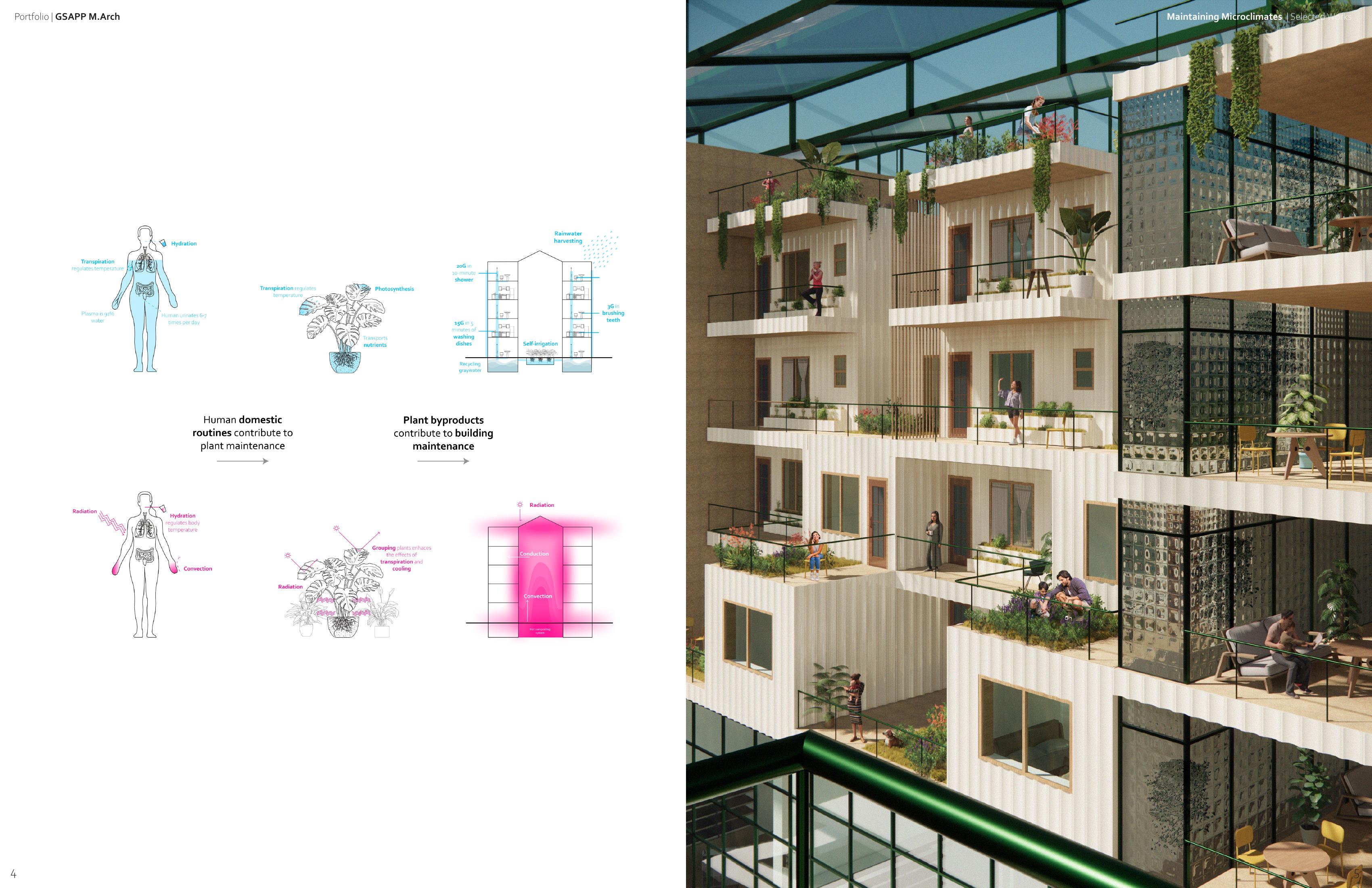
What does it mean to co-live with compost? How does soil shape our domestic space? Just by going about our routines, we are active participants in a sequence of microclimate interactions that maintain our bodies, our surrounding plant ecosystems, our buildings, and our communities.
Context & Community
This project is situated in West Harlem, surrounded by a network of community gardens. While many of these gardens are not well-maintained, they play a crucial role in empowering local communities by enabling them to take control of their food sources. Understanding the additional labor burden that preserving these spaces entails led us to ask: How can we make a building that both empowers residents to maintain their own public and private spaces, but also alleviates them of the burden of having to do all the work?
Design Concept
Maintaining Microclimates places compost at the core of the domestic routine, understanding the residence as a means by which communities co-produce byproducts, or “co-compost.” Co-composting is expressed through communal compost chutes which both serve as building waste infrastructure and create shared domestic experiences. Compost lands in a hot composting system beneath the building — a small routine act which kickstarts a larger building-scaled process: the upwards release of heat and humidity that maintains the courtyard and greenhouse space above.
Design Strategy
The intervention follows three key principles: Proportion — adopting the scale of the existing building; Terraces — arranging apartments in terraced formation to enable gravity-assisted irrigation and communal engagement in inner balconies; and Greenhouse — using the building’s envelope to create a microclimate for personal and communal growing spaces.
Building Systems
The apartment units are strategically arranged around a central wall chute that houses all water pipes and a heat waste extractor. This setup ensures efficient use and recycling of water while contributing to the optimization of the courtyard’s microclimate. All bedrooms are oriented towards the courtyard, maximizing thermal benefits from the collected heat and enhancing comfort and energy efficiency.
The water system features a root filtering system at the greenhouse level, with a terraced wall irrigation system that uses greywater collection and gravity-fed distribution. Underground tanks separate potable water from greywater for reuse. The heating system leverages geothermal heat exchange through the underground hot compost room, with conditioned air rising through the building to maintain the greenhouse above.